
In the great, sprawling game of life, we are all first-person players. We navigate the world through our own eyes, making choices and reacting to what comes our way. And while the scenery might be different for each of us, the fundamental “player types” are surprisingly similar. These aren’t defined by looks or background, but by something much deeper: the placement of the heart.

Imagine two main character classes. One is the Altruist, and the other is the Egoist.
The Altruist is a player whose heart is placed firmly outside of themselves, focused on the well-being of others. Their primary mission is to help, to heal, to lift up. Their “gameplay” often involves sharing resources, offering a helping hand, and feeling a deep, unselfish concern for the group. They may not always win the grand prize or accumulate the most power, but their victories are measured in the flourishing of those around them. This player finds joy not in personal gain, but in collective good.
This perspective is deeply rooted in scripture. As it says in Galatians 5:13, “For you were called to freedom, brothers. Only do not use your freedom as an opportunity for the flesh, but through love serve one another.” The Altruist embodies this call to service, understanding that true freedom comes not from self-interest, but from loving and serving others.
Think of a person who has a stable home and a spare bedroom. They get a call from an old friend or a family member who has fallen on hard times—they’ve lost their job and are on the brink of homelessness. The Altruist would open their door without a second thought, offering not just a place to stay for a few nights but a month or more, even if it means sacrificing their privacy and peace. They do this because they understand that providing a healthy, stable relationship is the true key to helping someone get their life in order. It’s not just about a temporary fix; it’s about providing a life-changing foundation.
The Egoist, by contrast, has their heart placed squarely within themselves. Their primary mission is self-preservation and personal gain. Their “gameplay” is a strategic pursuit of what benefits them directly—whether it’s success, wealth, or power. This doesn’t necessarily make them a villain. An Egoist can be a brilliant innovator, a resilient survivor, or a fierce competitor. Their motivation isn’t to harm others, but simply to advance their own standing. Their sense of accomplishment comes from achieving personal goals, not from helping others achieve theirs.
Consider that same life-changing scenario. The Egoist, faced with the same request, would weigh the costs. They might feel sympathy, but they would also think about the potential disruption to their routine, the financial burden, and the loss of their personal space. They would be more likely to offer to pay a month’s rent for the person somewhere else, or give them a sum of money to help them, in order to avoid the direct intrusion into their own life. Their focus is on protecting the stability and privacy they have built for themselves, and they are not willing to sacrifice that for someone else.
The Blended Player: Finding a Healthy Balance
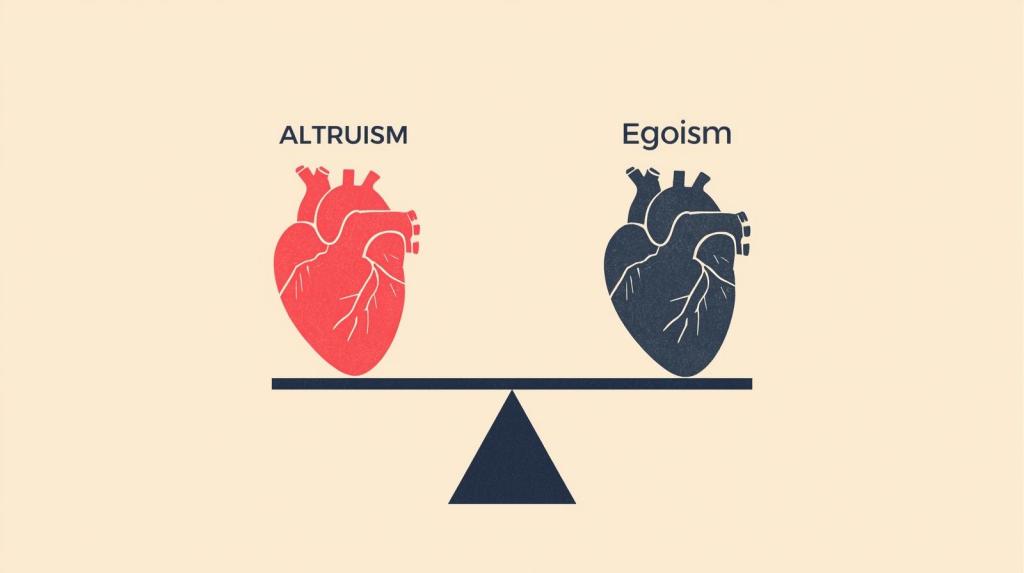
Most of us aren’t purely one or the other. We often find ourselves as Blended players, moving between altruistic and egoistic actions depending on the situation. We can be selfless in one moment and self-serving in the next. The real insight isn’t in labeling ourselves as one type, but in understanding which part of us is driving our choices at any given time.
This balance can be a difficult one to strike, especially if you’ve been on the receiving end of pure altruism. You might feel a deep sense of gratitude and a desire to repay that kindness, but it’s important to understand the difference between healthy and unhealthy extremes.
An unhealthy Egoist can devolve into narcissism—an excessive, grandiose self-obsession that lacks empathy and requires constant admiration. It’s a self-destructive state that harms both the person and those around them.
On the other side, an unhealthy Altruist can suffer from pathological altruism or a martyr complex. This is when a person’s helping behaviors become obsessive and self-sacrificial to the point of personal harm. It’s often driven by a subconscious need for validation or a feeling of worthlessness if they aren’t constantly helping. This can lead to burnout, resentment, and a complete lack of boundaries, where they enable others’ dependency while neglecting their own health and needs.

The key to a healthy life is to find the middle ground. It’s about recognizing that your own worth is not tied to how much you sacrifice for others, and that taking care of yourself is not selfish, but essential. By setting healthy boundaries and learning to fill your own cup, you can be both the person who helps and the person who thrives.
The placement of the heart is what determines our ultimate goal in the game of life. Do you play to lift up others, or to lift up yourself? There’s no right or wrong answer, but understanding the motivation behind your actions is the key to truly understanding the game you’re playing.

Don’t Worry About Burning Ur Lips on This Tea